
Artists Formerly Known

All Pueblos

Several hundred years ago, during the times of the great Southwest migrations, communal feasting developed as a means of meet-and-greet for integrating or rejecting newcomers into established villages. That's about the same time large open serving bowls came into existence. Families would prepare their specialty dish and bring it to share at the feast in their own bowls. When the feast was over, they retrieved their bowls and went back home until next time. They found ways to differentiate each family's bowls from the others, making them easy to recognize and retrieve. Those innovations have, in some cases, carried forward almost to today. Some were in the actual construction of the pots while others were in the execution of the decorations on them.

For instance, Nampeyo was known to have added an extra coil to the rims of her pieces, as she was aware of that being a breakage point should the piece actually be put into some kind of use. Today, "use" is not a consideration and rims have consequently become very thin. Nampeyo was also known for decorations that were slightly off balance, not quite direct copies of anything else on the piece.

Florentino Montoya, of San Ildefonso, was known for particular off-balance flourishes in his designs, used today to identify his pieces as he never signed any. He and his wife, Martina Vigil, were making pottery in the late 1800's. It was they who got Maria Martinez started when she was a young girl.

In general, most pieces of pottery made before the early 1950's were unsigned, their creators, for the most part, now unknown. Only a very few potters, ones who had become convinced of the monetary value of their name on the bottom of a piece, signed anything.

Maria Martinez of San Ildefonso was one of the very first, beginning in 1922. That caused a problem as the outside world then came looking for her in particular, as someone they really wanted to do business with. Then, in 1926, she added her husband's name to the signature as he was doing all the decorating for her. That caused another upheaval among the pueblos as the making of pottery was long considered to be "women's work."

Nampeyo, at Hopi, was also getting established as a potter of note around the same time, but she never learned English, never learned to read or write. As Nampeyo went blind and other members of her family began painting for her, some would sign pieces with her name and theirs, as in "Nampeyo Fannie," on a pot made by Nampeyo and painted by her daughter Fannie. Nampeyo's niece Daisy painted some, too, usually signing some version of "Nampeyo Daisy" or "Nampeyo DHN". Nampeyo's daughter, Annie Healing, worked side by side with Nampeyo for years, doing a lot of her decorating, but Annie never signed either name to anything. At this point in time, we know what to look for to attribute the making and decorating of a pot to Nampeyo but with pieces made after about 1920, it's essentially impossible to tell what was done by Nampeyo and what was done by Annie.

As the outside world began to learn of Nampeyo's art and the art being produced by others on the Hopi mesas, some of the traders, dealers and archaeologists who went to Hopi found that most potters had a hard time reading and writing English. They also didn't recognize the English names that had been given to them. Knowing the value of being able to attribute a particularly well-done piece to a particular potter, the dealers and traders began putting effort into getting the potters to develop "hallmarks," icons to use as identifiers. Marcia Rickey, with her "Flying Ant" avatar was one of the first of those. Sadie Adams with her five-petaled flower was another. Others developed over the years include "Frogwoman" (Navasie family), "Featherwoman" (Naha family), "Carried in Beauty" (Preston Duwyenie), "Antelope Woman" (Zella Cheeda) and more. In the early 1950's that developed into more full-scale signatures, although many continued adding family and clan hallmarks, some just adding small indicators of their own (such as: a distinct "Featherwoman" feather with an "S", meaning Sylvia Naha).

The 1950's saw a renaissance in pottery making among virtually all the pueblos, and with that came full signatures almost everywhere, some with hallmarks and some without. And some potters still use only hallmarks...


100 West San Francisco Street, Santa Fe, New Mexico 87501
(505) 986-1234 - www.andreafisherpottery.com - All Rights Reserved


Zia Pueblo

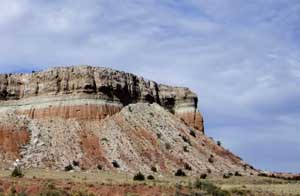
Zia Reservation view
A typical view on the Zia Pueblo Reservation

Zia Pueblo is situated in the Jemez Mountains with Jemez Pueblo to the north and Santa Ana Pueblo to the south. Despite its picture postcard setting, Zia's history for the last four hundred years has been difficult.

Antonio de Espejo led a small troop of Spanish explorers up the Jemez River and discovered Zia Pueblo in 1583. Espejo estimated there were about 4,000 inhabitants in a city of house blocks up to three and four stories high with five major plazas and many smaller ones. "The people are clean. The women wear a blanket over their shoulders tied with a sash at their waist - their hair cut in front, and the rest plaited so that it forms two braids, and above a blanket of turkey feathers," is how Espejo's scribe recorded it.

Zia today is a water-poor community of about 800, most of whose residents work away from the pueblo.

The people of Zia participated in the Pueblo Revolt of 1680 and when Spanish troops returned in 1682 and 1687, the Zias were able to repulse them. When more Spanish troops returned in 1688 they were finally successful in conquering the Zias. The Spanish killed many people, burned the pueblo and took many slaves back to Mexico with them. When Don Diego de Vargas returned to northern Nuevo Mexico in 1692, the Zias sued for peace and accepted the rule of Spain almost immediately. However, the new Spanish government did little to protect the pueblos from the raids of nomadic Ute, Apache, Comanche and Navajo warriors. Zia fortunes slid in many ways and by the 1890's the tribe was down to just 98 members.

Today, the Pueblo of Zia numbers about 800 people, many of whom are active artists producing everything from pottery to jewelry to baskets to paintings, sculptures and wood carvings.

Pottery was a Zia mainstay for at least two hundred years. The balance of trade was food from Santa Ana, Jemez and San Felipe in return for pottery from Zia. Pottery still remains Zia's largest home-grown cash crop.

Zia pottery is Keresan and as such, shares design characteristics with other important Keresan pottery, especially Acoma and Laguna ware. They all have their favorite geometric patterns, stylized birds, rainbows and flowers, but each maintains its own individual images and colors.

Where Acoma and Laguna's bird is a parrot, Zia's is a roadrunner. Acoma's black and orange on stark white is contrasted by Zia's dark brown and brownish red on creamy white. Further, Acoma's hard, paper-thin, white clay ollas differ greatly from Zia's sturdy, slightly granular, basalt-tempered red clay jars. Because of their unique local clay and their traditional designs and shapes, Zia pottery is unique and easily distinguished from the pottery of other pueblos.

When New Mexico became a territory (and then a state), some of the symbols involved were sourced from Zia Pueblo. The roadrunner often pictured on Zia pottery became the official New Mexico state bird and the Zia sun symbol (a circle with four parallel lines in four groups pointing in the four directions) became a state symbol depicted in many places, including the state flag.
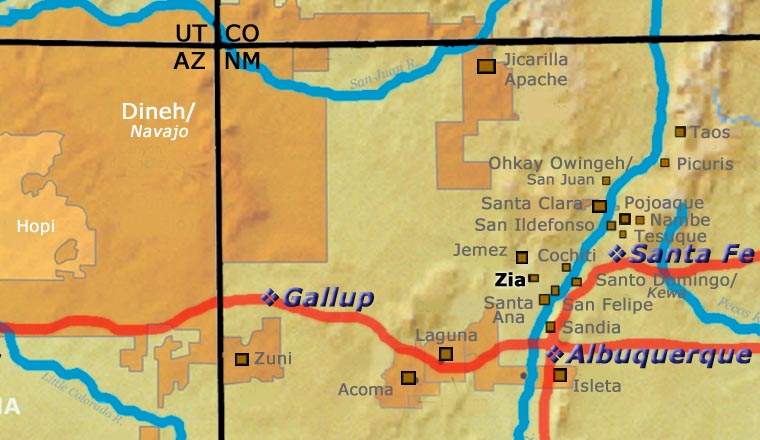
Map showing the location of Zia Pueblo

For more info:
at Wikipedia
Pueblos of the Rio Grande, Daniel Gibson, ISBN-13:978-1-887896-26-9, Rio Nuevo Publishers, 2001
Photo courtesy of Jared Tarbell, Creative Commons Attribution 2.0 Generic License


100 West San Francisco Street, Santa Fe, New Mexico 87501
(505) 986-1234 - www.andreafisherpottery.com - All Rights Reserved