
Artists Formerly Known
All Pueblos
Several hundred years ago, during the times of the great Southwest migrations, communal feasting developed as a means of meet-and-greet for integrating or rejecting newcomers into established villages. That's about the same time large open serving bowls came into existence. Families would prepare their specialty dish and bring it to share at the feast in their own bowls. When the feast was over, they retrieved their bowls and went back home until next time. They found ways to differentiate each family's bowls from the others, making them easy to recognize and retrieve. Those innovations have, in some cases, carried forward almost to today. Some were in the actual construction of the pots while others were in the execution of the decorations on them.
For instance, Nampeyo was known to have added an extra coil to the rims of her pieces, as she was aware of that being a breakage point should the piece actually be put into some kind of use. Today, "use" is not a consideration and rims have consequently become very thin. Nampeyo was also known for decorations that were slightly off balance, not quite direct copies of anything else on the piece.
Florentino Montoya, of San Ildefonso, was known for particular off-balance flourishes in his designs, used today to identify his pieces as he never signed any. He and his wife, Martina Vigil, were making pottery in the late 1800's. It was they who got Maria Martinez started when she was a young girl.
In general, most pieces of pottery made before the early 1950's were unsigned, their creators, for the most part, now unknown. Only a very few potters, ones who had become convinced of the monetary value of their name on the bottom of a piece, signed anything.
Maria Martinez of San Ildefonso was one of the very first, beginning in 1922. That caused a problem as the outside world then came looking for her in particular, as someone they really wanted to do business with. Then, in 1926, she added her husband's name to the signature as he was doing all the decorating for her. That caused another upheaval among the pueblos as the making of pottery was long considered to be "women's work."
Nampeyo, at Hopi, was also getting established as a potter of note around the same time, but she never learned English, never learned to read or write. As Nampeyo went blind and other members of her family began painting for her, some would sign pieces with her name and theirs, as in "Nampeyo Fannie," on a pot made by Nampeyo and painted by her daughter Fannie. Nampeyo's niece Daisy painted some, too, usually signing some version of "Nampeyo Daisy" or "Nampeyo DHN". Nampeyo's daughter, Annie Healing, worked side by side with Nampeyo for years, doing a lot of her decorating, but Annie never signed either name to anything. At this point in time, we know what to look for to attribute the making and decorating of a pot to Nampeyo but with pieces made after about 1920, it's essentially impossible to tell what was done by Nampeyo and what was done by Annie.
As the outside world began to learn of Nampeyo's art and the art being produced by others on the Hopi mesas, some of the traders, dealers and archaeologists who went to Hopi found that most potters had a hard time reading and writing English. They also didn't recognize the English names that had been given to them. Knowing the value of being able to attribute a particularly well-done piece to a particular potter, the dealers and traders began putting effort into getting the potters to develop "hallmarks," icons to use as identifiers. Marcia Rickey, with her "Flying Ant" avatar was one of the first of those. Sadie Adams with her five-petaled flower was another. Others developed over the years include "Frogwoman" (Navasie family), "Featherwoman" (Naha family), "Carried in Beauty" (Preston Duwyenie), "Antelope Woman" (Zella Cheeda) and more. In the early 1950's that developed into more full-scale signatures, although many continued adding family and clan hallmarks, some just adding small indicators of their own (such as: a distinct "Featherwoman" feather with an "S", meaning Sylvia Naha).
The 1950's saw a renaissance in pottery making among virtually all the pueblos, and with that came full signatures almost everywhere, some with hallmarks and some without. And some potters still use only hallmarks...
100 West San Francisco Street, Santa Fe, New Mexico 87501
(505) 986-1234 - www.andreafisherpottery.com - All Rights Reserved
Cochiti Pueblo

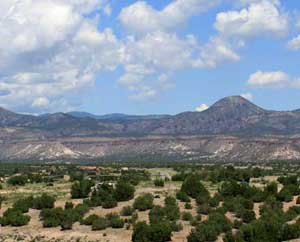
View west across Cochiti Pueblo
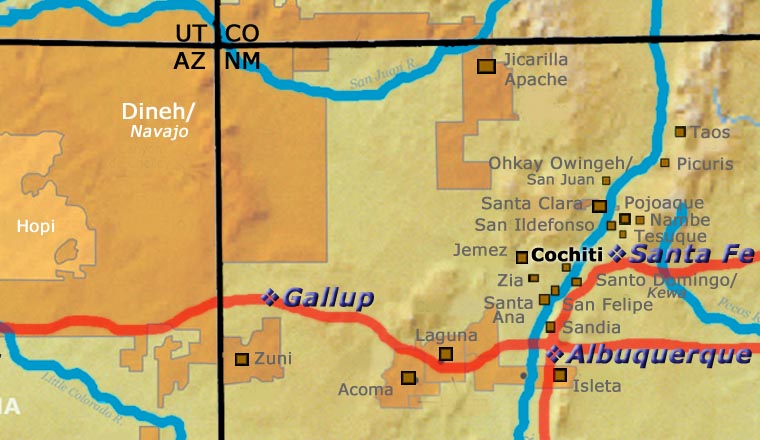
Cochiti Pueblo lies fifteen miles south of Santa Fe along the west bank of the Rio Grande. Frijoles Canyon in what is now Bandelier National Monument is the site of the pueblo's most recent ancestral home. The Eastern Keresans may have relocated to the Bandelier area from the Four Corners region around 1300.
Cochiti legend says that Clay Old Woman and Clay Old Man came to visit the Cochitis. While all the people watched, Clay Old Woman shaped a pot. Clay Old Man danced too close and kicked the pot. He rolled the clay from the broken pot into a ball, gave a piece to all the women in the village and told them never to forget to make pottery.
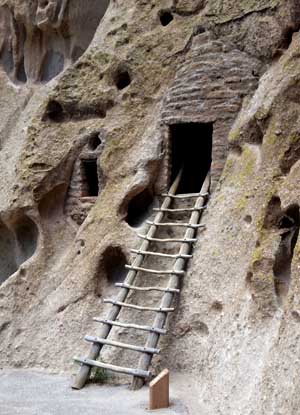
At Bandelier National Monument
In prehistoric times, human effigy pots, animals, duck canteens and bird shaped pitchers with beaks as spouts were common productions of the Cochiti potters. Many of these were condemned as idols and destroyed by the Franciscan priests. That problem stopped when the Spanish left in 1820 but the fantastic array of figurines created by Cochiti potters was essentially dormant until the railroad arrived. Then Cochiti potters were among the first to enter the tourist market and they produced many whimsical figures into the early 1900s. Then production followed the market into more conventional shapes.
Legend has it that a Ringling Brothers Circus train broke down near Cochiti Pueblo in the 1920s. Supposedly, the tribe's contact with the ringmaster, trapeze artists, opera singers, sideshow "freaks" and exotic animals paved the way for a variety of new figural subjects. However, shortly after the railroad passed through, a delegation of Cochiti men got on the train and traveled to Washington DC. There they were introduced to the President, spoke to Congress, and were taken on a tour of the "highlights" of American civilization in Washington and in New York City, incuding the Metropolitan Opera, the Bronx Zoo and a performance of the Ringling Brothers Circus. As none of the men could read or write, nor draw, what they brought back to Cochiti was what they remembered of things they had never seen before. As their stories spread arond the village, elements of the stories grew and deformed. An astute observer will find angels, nativities, cowboys, tourist caricatures, snakes, dinosaurs, turtles, goats, two-headed opera singers, clowns, tattooed strongmen, Moorish nuns and even mermaids in the Cochiti pottery pantheon, many produced only since the early 1960s and based on characters described in Cochiti's oral history.
A few modern potters make traditional styled pots with black and red flowers, animals, clouds, lightning and geometric designs but most Cochiti pottery artists now create figurines. Most notable is the storyteller, a grandfather or grandmother figure with "babies" perched on it. Helen Cordero is credited with creating the first storyteller in 1964 to honor her grandfather. The storyteller style was quickly picked up by other pueblos and each modified the form to match their local situation (ie: clay colors and tribal and religious traditions). In some pueblos, storytellers are also now made as drummers and as a large variety of animals.
Today, Cochiti potters face the challenge of acquiring the clay for the white slip. Construction of Cochiti Dam in the 1960s destroyed their primary source of their trademark white slip and gray clay. Now the white slip comes from one dwindling source at Santo Domingo, Cochiti Pueblo's neighbor to the south.
Most outsiders who visit Cochiti Pueblo these days do so on the way to or from either the recreation area on Cochiti Lake or Kasha-Katuwe Tent Rocks National Monument.
100 West San Francisco Street, Santa Fe, New Mexico 87501
(505) 986-1234 - www.andreafisherpottery.com - All Rights Reserved
