
Rainy Naha
Hopi
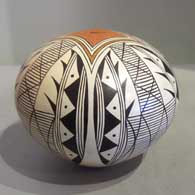
Rainy Naha, a member of the Tewa Spider clan, was born to Helen Naha at the village of Hano on First Mesa in 1949. Like her siblings, Burel and Sylvia, she learned how to make pottery the traditional way from her mother (the original Featherwoman).
Each piece begins with digging and processing the clay and making the slips and paints. When the clay is ready it's rolled into snakes and hand-coiled and shaped into the form of the pot. Then it's allowed to dry for a few days. Once a piece is dry and sanded, the white slip is applied. This is a difficult step because if the white slip is not stone polished at the right speed, it will begin to flake and peel off the piece. Finally, the design is painted on the piece and in the final step it is fired outdoors in the traditional manner. Rainy is methodical in her work and one of her larger pieces, from forming the bowl to firing it, may take 100 or more hours to finish.
It's Rainy's intricate designs that make her pieces stand out. She's also known for making thin walled vessels in both traditional and contemporary shapes. The designs she paints onto the vessels often incorporate elements of her mother's work, such as the Awatovi Star and bat wing patterns. However, Rainy also has her own repertoire of images to use. She is an active long distance runner and often comes across ancient pottery sherds around the ruins of Awatovi when she runs there. She studies these and may incorporate elements of them into her work. She majored in Archaeology at Brigham Young University and that training allows her to envision where a pot shard may fit into the structure of the original pot and the design that may have flowed around it. Once she gets that sorted out, she returns the shards to the earth.
Parrots, hummingbirds, bear paws and cloud patterns are among Rainy's additions to her family's design portfolio. Frequently her pieces have an eternity belt design, usually around the neck or shoulder of the bowl. This traditional pattern reflects the continuity of the Hopi-Tewa people. Rainy has also added different colored clay slips to her work with some pieces having up to five different colors!
Rainy has earned numerous awards at the Santa Fe Indian Market, the Eight Northern Pueblos Arts and Crafts Show, the Heard Museum Indian Market and other events. In 1997 she earned the "Challenge Award for Best Traditional Pottery," also known as the "Helen Naha (Featherwoman) Award."
Some Exhibits that Featured Rainy's Work
- Artistic Excellence: The Heard Museum Guild Indian Fair & Market Celebrates 60 Years. Heard Museum. Phoenix, Arizona. February 2, 2018 - August 31, 2018
- Elegance from Earth: Hopi Pottery. Heard Museum. Phoenix, Arizona. Opening: March 24, 2012
- Choices and Change: American Indian Artists in the Southwest. Heard Museum North. Scottsdale, Arizona. June 30, 2007 - 2013
- Magic in Clay: Artistic Miniatures of the American Southwest. University of Nebraska State Museum. Lincoln, Nebraska. 1991
Some of the Awards Won by Rainy
- 2020 Heard Museum Guild Indian Arts Fair & Market: Classification II - Pottery: Honorable Mention for Classification II. Awarded for artwork: “Palhik Mana Dolls” Vase
- 2019 Heard Museum Guild Indian Arts Fair & Market, Classification II - Pottery, Division G - Pottery miniatures not to exceed three (3) inches at its greatest dimension: Honorable Mention. Awarded for artwork: “The Enduring Strength of Women”
- 2019 Heard Museum Guild Indian Arts Fair & Market: Judge's Award - Ken Williams. Awarded for artwork: “The Enduring Strength of Women”
- 2017 Santa Fe Indian Market, Classification II - Pottery, Division B - Traditional, Category 601 - Painted polychrome pottery in the style of Hopi, any form: First Place
- 2017 Heard Museum Guild Indian Arts Fair & Market, Classification II Pottery, Division A - Painted, Native Clay, Hand Built, Fired Out-of-Doors: First Place. Awarded for Artwork: “Red Star”
- 2015 Heard Museum Guild Indian Arts Fair & Market, Classification II - Pottery, Division A - Traditional - native clay, hand built, painted: Second Place, Honorable Mention
- 2014 Heard Museum Guild Indian Arts Fair & Market, Classification II - Pottery, Division A - Traditional, native clay, hand built, painted: First Place. Awarded for artwork: “Red Star”
- 2013 Heard Museum Guild Indian Arts Fair & Market, Classification II - Pottery, Division A - Traditional, native clay, hand built, painted: Honorable Mention. Awarded for artwork: “Palhik Mana”
- 2011 Heard Museum Guild Indian Arts Fair & Market, Classification II - Pottery, Division A - Traditional, native clay, hand built, painted: Second Place
- 2011 Heard Museum Guild Indian Arts Fair & Market, Classification II - Pottery, Division E - Non-traditional design or form with native materials: Second Place
- 2010 Heard Museum Guild Indian Fair & Market, Classification II - Pottery, Division A - Traditional, native clay, hand built, painted: Second Place
- 2009 Heard Museum Guild Indian Arts Fair & Market, Classification II - Pottery, Division A - Traditional, native clay, hand built, painted: First Place
- 2008 Heard Museum Guild Indian Arts Fair & Market, Classification II - Pottery, Division A - Traditional, native clay, hand built, painted: Second Place
- 2007 Santa Fe Indian Market, Classification II - Pottery: Best of Classification
- 2007 SWAIA Fellowship Award for Pottery
- 2007 Heard Museum Guild Indian Arts Fair & Market, Classification II - Pottery, Division A - Traditional, native clay, hand built, painted: Honorable Mention
- 2006 Heard Museum Guild Indian Arts Fair & Market, Classification II - Pottery, Division A - Traditional-native clay/hand built/painted: First Place
- 2005 Heard Museum Guild Indian Arts Fair & Market, Classification VIII - Pottery, Division A - Traditional/native clay/hand-built (painted): Honorable Mention
- 2004 Santa Fe Indian Market Special Awards: Helen Naha Memorial Award for Excellence in Traditional Hopi Pottery
- 2004 Santa Fe Indian Market, Classification II - Pottery, Division F - Traditional pottery, painted designs on matte or semi-matte surface, all forms except jars, Category 1301 - Seed bowls, opening must be top center: Third Place
- 2003 Heard Museum Guild Indian Arts Fair & Market: Judge's Choice Award - Byron Hunter. Awarded for artwork: “Palhik Manas” pottery
- 2001 Santa Fe Indian Market, Classification II - Pottery, Division E - Traditional pottery, jars, painted designs on matte or semi-matte surface, jars, Category 1201 - Jars, Hopi: Second Place
- 2001 Santa Fe Indian Market, Classification II - Pottery, Division F - Traditional pottery, painted designs on matte or semi-matte surface, all forms except jars, Category 1304 - All vase forms including wedding vases: First Place
- 2001 Hopi Marketplace, Pottery Division, Polychrome bowls, jars, vases: First Place. Museum of Northern Arizona
- 2000 Santa Fe Indian Market, Classification II - Pottery, Division E - Traditional pottery, jars, painted designs on matte or semi-matte surface, jars, Category 1201 - Jars, Hopi (up to 6″ tall): First Place
- 2000 Santa Fe Indian Market, Classification II - Pottery, Division E - Traditional pottery, jars, painted designs on matte or semi-matte surface, jars, Category 1202 - Jars, Hopi (over 6″ tall): Third Place
- 2000 Santa Fe Indian Market, Classification II - Pottery, Division F - Traditional pottery, painted designs on matte or semi-matte surface, all forms except jars, Category 1302 - Seed bowls (over 7" in diameter): Second Place
- 1999 Santa Fe Indian Market, Classification II - Pottery, Division E - Traditional pottery, jars, painted designs on matte or semi-matte surface, jars, Category 1201 - Jars, Hopi (up to 6" tall): First Place
- 1999 Santa Fe Indian Market, Classification II - Pottery, Division F - Traditional pottery, painted designs on matte or semi-matte surface, all forms except jars, Category 1304 - Other bowl forms (over 9" in diameter): Third Place
- 1999 Santa Fe Indian Market, Classification II - Pottery, Division F - Traditional pottery, painted designs on matte or semi-matte surface, all forms except jars, Category 1306 - Other vases: First Place
- 1999 Hopi Marketplace: Best of Pottery Division. Museum of Northern Arizona
- 1999 Hopi Marketplace, Pottery Division, Miniatures, Polychrome jars, bowls & vases (under 8"): First Place. Museum of Northern Arizona
- 1999 Hopi Marketplace: Pottery Division, Miniatures, Polychrome jars, bowls & vases (under 8"): Second Place. Museum of Northern Arizona
- 1999 Hopi Marketplace: Pottery Division, Miniatures, Polychrome jars, bowls & vases (under 8"): Third Place. Museum of Northern Arizona
- 1998 Santa Fe Indian Market, Classification II - Pottery, Division E - Traditional pottery, jars, painted designs on matte or semi-matte surface, jars (in the style of Hopi, Acoma, Laguna), Category 1201 - Jars, Hopi (up to 6" tall): Second Place
- 1998 Hopi Marketplace: Best of Pottery Division. Museum of Northern Arizona
- 1998 Hopi Marketplace, Pottery Division, Polychrome bowls & jars: First Place. Museum of Northern Arizona
- 1998 Hopi Marketplace, Pottery Division, Polychrome bowls & jars: Honorable Mention. Museum of Northern Arizona
- 1998 Hopi Marketplace, Pottery Division, Polychrome jars and bowls, First Place. Museum of Northern Arizona
- 1998 Hopi Marketplace, Pottery Division, Polychrome vases: First Place. Museum of Northern Arizona
- 1997 Santa Fe Indian Market, Challenge Award in Traditional Pottery
- 1997 Hopi Marketplace, Pottery Division, Polychrome seed bowls: First Place. Museum of Northern Arizona
- 1997 Hopi Marketplace, Pottery Division, Polychrome seed bowls: Second Place. Museum of Northern Arizona
- 1997 Hopi Marketplace, Pottery Division, Polychrome canteens, wedding vases: First Place. Museum of Northern Arizona
- 1996 Santa Fe Indian Market, Classification II - Pottery, Division E - Traditional pottery, jars, painted designs on matte or semi-matte surface, jars, Category 1201 - Jars, Hopi (up to 6" tall): Third Place
- 1996 Santa Fe Indian Market, Classification II - Pottery, Division E - Traditional pottery, jars, painted designs on matte or semi-matte surface, jars, Category 1301 - Seed bowls (up to 7" in diameter): First Place
- 1996 Santa Fe Indian Market, Classification II - Pottery, Division E - Traditional pottery, jars, painted designs on matte or semi-matte surface, jars, Category 1305 - Wedding vases: Second Place
- 1996 Santa Fe Indian Market, Classification II - Pottery, Division J - Pottery miniatures, 3" or less in height or diameter, Category 1606 - Traditional forms, vases (including wedding vases), black: First Place
- 1996 Hopi Marketplace: Best of Pottery Division. Museum of Northern Arizona
- 1996 Hopi Marketplace, Pottery Division, Polychrome bowls & jars: First Place. Museum of Northern Arizona
- 1996 Hopi Marketplace, Pottery Division, Polychrome bowls & jars: Honorable Mention. Museum of Northern Arizona
- 1995 Santa Fe Indian Market, Classification II - Pottery, Division F - Traditional pottery, painted designs on matte or semi-matte surface, jars, Category 1301 - Jars, Hopi (up to 9" inches" tall): Second Place
- 1995 Santa Fe Indian Market, Classification II - Pottery, Division K - Pottery miniatures, 3" or less in height or diameter, Category 1702 - Traditional forms-jars, other colors including two-tone: Second Place
- 1995 Hopi Marketplace, Pottery Division - Miniatures: First Place. Museum of Northern Arizona
- 1994 Santa Fe Indian Market, Classification II - Pottery, Division G - Traditional pottery, painted designs on matte or semi-matte surface, all forms except jars, Category 1406 -0ther vases: Third Place
- 1994 Santa Fe Indian Market, Classification II - Pottery, Division G - Traditional pottery, painted designs on matte or semi-matte surface, all forms except jars, Category 1408 - Plates: Third Place
100 West San Francisco Street, Santa Fe, New Mexico 87501
(505) 986-1234 - www.andreafisherpottery.com - All Rights Reserved

The Hopi People
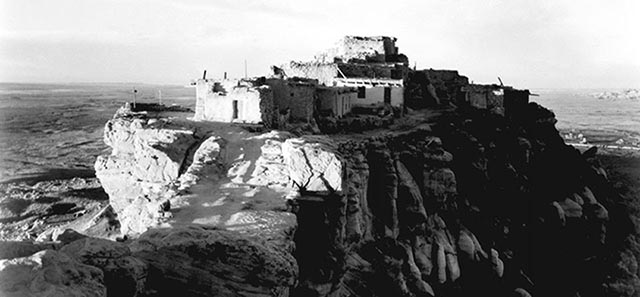
Walpi, as seen by Ansel Adams in 1941
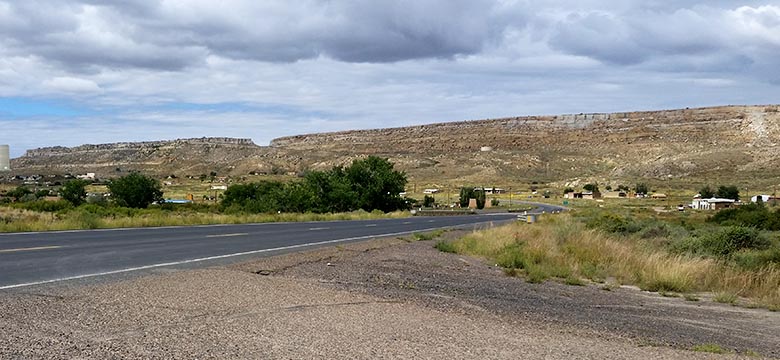
Looking across Tewa Village to First Mesa
The Hopi People and Their Pottery
Pottery was being made in the area of the Hopi mesas before generational migrants from the area of central Mexico began to arrive in the 600's. Those migrants brought a much better ceramic technology with them. They also brought a whole new design vocabulary, architectural advancements, more defined rituals and better seeds, along with other agricultural advancements. They spread out across the Southwest between the Colorado River and the Rio Grande, from the Chihuahua and Sonora deserts north to the Great Salt Lake, and they multiplied. The weather of this countryside was very fickle, though, and they had to discover new ways to store their food and keep it good for years. The best tool for preserving things was pottery. Then they began decorating their pottery with their prayers for the seed within, and for the survival of their people.
For hundreds of years those designs were repetitive geometrics, in black-on-white or black-on-gray-white bisques, most matte but more and more polished as time went on. In the 900's, from the south again, figures in black-on-white were introduced. Then came figures and designs in red-and-black-on-white. Then came figures and designs in various combinations of red, black and white on various backgrounds. Each step in the development of decorative and color schemes is reflective of experiential religious developments within one clan or another, one pueblo or another. A lot of what flowered into what we know now as "Sikyátki style and design" was developed in bits and pieces along the rim of Antelope Mesa. It took the experience of Sikyátki to put it all together. Just as the design palette of Sikyátki reached its peak, the village's chief determined they had strayed too far from the traditionally conservative Hopi path and they needed to be put to death for it. He arranged with the elders of Walpi and other villages to have the deed done and sometime in 1625 it was completed. Everyone in the village was killed except for a few ritual specialists who were saved for their spiritual value.
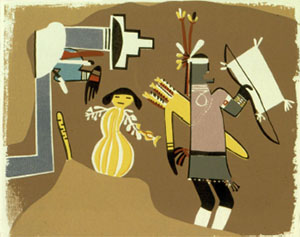
From a mural found at Awatovi
The styles and designs of Sikyátki lived on on some Awatovi pottery for a few years but the entire design palette changed after the Spanish arrived in force in 1629. San Bernardo Polychrome came into production almost immediately with the reduction in labor force as so many of the Awatovis were forced to serve the priests and build a mission. The design palette changed, too, when all the kachina designs were forced out by the Franciscan priests. Almost everything changed again with the Pueblo Revolt of 1680. There was a general return to themes prevalent before the Spanish arrived across the entire Southwest, except by then most potters were firing their pots using sheep, cow or horse manure. Around the Hopi mesas, a merging of designs and supernaturals with the layouts from the San Bernardo and Sikyatki phases happened. Some archaeologists have termed the pottery that was produced for 100 years after the Pueblo Revolt as "Payupki phase." It faded out around 1780, about the same time the last of the Tiwas and Keresans returned to the Rio Grande Valley from the village of Payupki on Second Mesa. After that came the phases of Polacca Polychrome, including the white-slipped years after the times of drought and disease in the 1800s that were spent at Zuni.
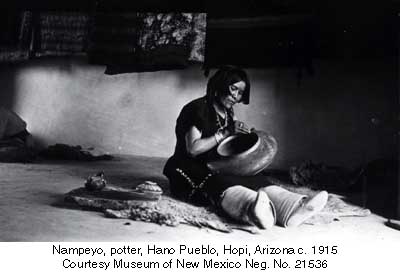
By the mid-1800s, the Hopi pottery tradition had been almost completely abandoned, its utilitarian purposes taken over by cheap enamelware brought in by Anglo traders. Hopi pottery production sputtered along until the 1880's when one woman, Nampeyo of Hano, almost single-handedly revived it. Nampeyo lived in Hano on First Mesa and was inspired by pot sherds found among the nearby ruins of the ancient village of Sikyátki. Like every other potter around First Mesa at the time, Nampeyo was producing jars, bowls and canteens, often with one surface slipped white and decorated with designs in black-and/or-red. At the urging of Anglo traders' Alexander Stephen and Thomas Varker Keam, she began experimenting with polishing the surface of pieces coiled entirely of Jeddito yellow clay and then painting her designs directly on that. Today, credit is given to Nampeyo for fully reviving the Sikyátki style. She was so good that Jesse Walter Fewkes, the first archaeologist to formally excavate Sikyátki, was concerned that her creations would shortly become confused with those made hundreds of years previously.
Sikyátki pottery shapes are very distinctive: flattened jars with wide shoulders; low, open serving bowls decorated inside; seed jars with small openings and flat tops; painting methods of splattering and stippling and very distinctive designs. The Sikyátki style seems to have evolved as various Zuni-, Keres- and Towa-speaking potters came together with Water Clan potters from the Hohokam areas of southern Arizona and northern Mexico, and they began working with clays found in the nearby Jeddito valley area. Over the years, other clans came to the area and made their own contributions to what we now refer to as "Sikyátki Polychrome." According to Jesse Walter Fewkes, that merging of styles, techniques and designs created some of the finest ceramics ever produced in prehistoric North America.
Today's Hopi Pottery
Most Hopi pottery is unmistakable in its shapes, colors and designs. The Hopis are blessed with multiple excellent clay sources, each offering a different deep color after polishing and firing. Most Hopi pottery uses a buff, red, white or yellow clay body. Some kachina carvers make pottery and sometimes carve and etch their surfaces. Most Hopi potters, though, form their pieces and paint their decorations using colors derived from boiled-down plants, watered-down clay and from crushed minerals.
Much of the symbology painted on Hopi pottery is themed with "bird elements:" eagle and parrot tails, feathers, beaks and wings, and with katsinam (images of their gods) and permutations of migration patterns. Many Hopi, Hopi-Tewa and Tewa potters are members of the Corn Clan and their annual religious cycle revolves around the seasons of corn. The vast majority of today's Hopi pottery shapes and the designs painted on them are obvious descendants of the work of potters who existed 200-and-more years ago.
The above paragraph applies mostly to potters from the vicinity of First Mesa. The few potters from Second and Third Mesas seem to derive their design palettes from farther back in time, to the geometric designs, patterns and figures of the rock art prevalent before the advent of the katsinam, and the emergence of the Medicine, Sacred Clown and Warrior societies 800 years ago.
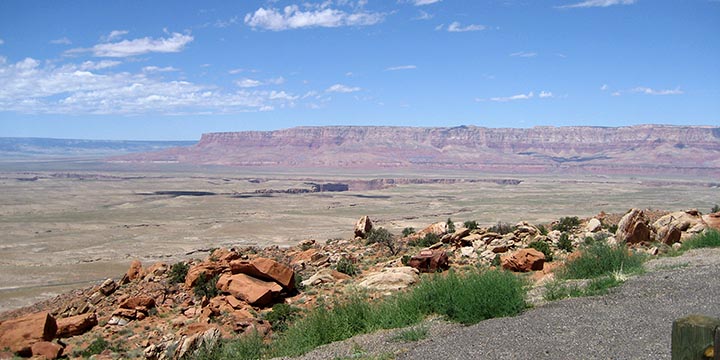
The view south from near Old Oraibi
Other Resources:
100 West San Francisco Street, Santa Fe, New Mexico 87501
(505) 986-1234 - www.andreafisherpottery.com - All Rights Reserved