Alvin Curran
1953-2000
Ohkay Owingeh

Alvin Curran was born in 1953 on the Yuma-Quechan Reservation in the Colorado River Valley, on the border of Arizona and California. At the age of one he went to live with his maternal grandparents at Ohkay Owingeh. He grew up at Ohkay Owingeh, graduated from Espanola High School and studied law enforcement at Monterey Peninsula College. Then he returned to Ohkay Owingeh and worked on the police force, eventually serving as Chief of Police for four years.
Alvin met his wife, Dolores, when he took a jewelry class sponsored by the Ohkay Owingeh Arts & Crafts Coop. They married in 1978 and she moved to his home at Ohkay Owingeh (Dolores is from Santa Clara). They had 2 children together.
When Alvin's health began to suffer, he decided it was time to leave the Police Department. That's when his mother-in-law, Ursulita Naranjo, encouraged him to become a potter. She gave him clay and told him to make something. He made a few animal figures that she polished and fired for him. She told him he had a great opening looking him in the face: there were only a few Ohkay Owingeh potters and none were men. Most were elderly women. Then he began to learn in earnest.
After years of work, Alvin developed his own version of the Potsuwi'i jar. Most Potsuwi'i design leaves a lot of open space between major elements but Alvin liked to fill in open areas with detailed decorations. Then he fired his pieces the traditional way, outdoors on the ground.
Alvin was a participant in the Santa Fe Indian Market in 1992, 1993, 1994, 1996 and 1997, winning awards every time. He said he liked to be working on 3 pots at the same time. He also liked to fire three pots at the same time. Alvin passed on in 2000.
Some of the Awards Alvin won
- 1997 Santa Fe Indian Market, Classification II - pottery, Division C - traditional pottery, Category 1008 - plates: First Place
- 1996 Santa Fe Indian Market, Classification II - pottery, Division C - traditional pottery, Category 1008 - plates: Second Place
- 1994 Santa Fe Indian Market, Classification II - pottery, Division C - traditional pottery, Category 1001 - San Juan Style: First Place
- 1993 Santa Fe Indian Market, Classification II - pottery, Division C - traditional pottery, Best of Division; - Category 1001: First Place & Second Place
- 1992 Santa Fe Indian Market, Classification II - pottery, Division C - traditional pottery. Category 1001 - all forms: First Place & Second Place
100 West San Francisco Street, Santa Fe, New Mexico 87501
(505) 986-1234 - www.andreafisherpottery.com - All Rights Reserved

Ohkay Owingeh (San Juan)
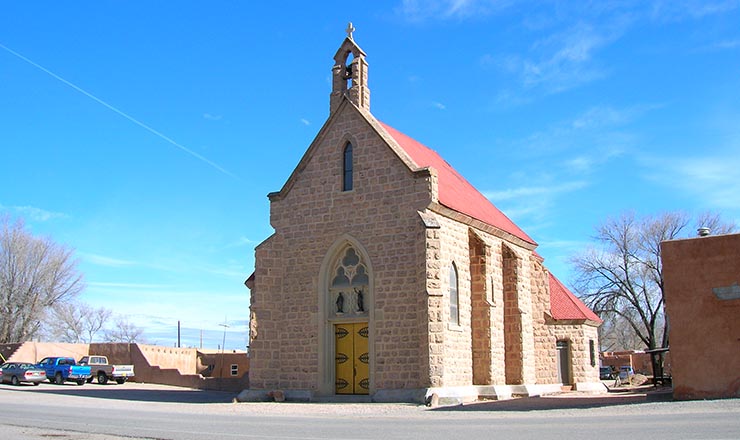
Ohkay Owingeh Mission
Ohkay Owingeh has a long history of pottery-making. Archaeologists even date certain timespans in the Pueblo II era by the San Juan Polychrome and San Juan Blackware potsherds that have been found in many digs. The styles were so striking for the time that archaeologists have been able to reconstruct trade routes by the date of appearance of those styles in different pueblos. But the making of pottery in the traditional way is not so widespread at Ohkay Owingeh these days.
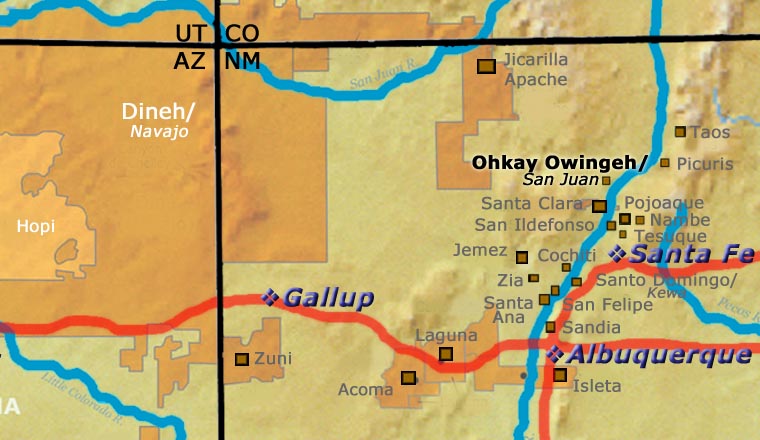
In 2005 San Juan Pueblo officially changed its name back to the original name (before the Spanish arrived): Ohkay Owingeh (meaning: Place of the strong people). There are numerous abandoned ancient pueblos in the countryside around today's primary village of Ohkay Owingeh that have been archaeologically excavated and dated, but none of those excavations have yielded a date for the establishment of the village on the east side of the Rio Grande that was discovered by Don Juan de Oñaté in 1597.
The people of Ohkay Owingeh speak Tewa, and may have come to the Rio Grande area from southwestern Colorado or from the San Luis Valley in central Colorado. There is an archaeological record that possibly tracks their ancestors as they moved downstream through the valleys of the Ojo Caliente and Chama Rivers to the Rio Grande in the 1300 and 1400s. There is also an archaeological history showing there were Tanoan groups living in the area for hundreds of years before that.
Spanish conquistador Don Juan de Oñate took control of Ohkay Owingeh in 1598, renaming it San Juan de los Caballeros (after his patron saint, John the Baptist). He established the first Spanish capitol of Nuevo Mexico across the Rio Grande in the village of Yugue-Yunqué, an area he renamed San Gabriel. In 1608, the capitol was moved south to an uninhabited area that became the Santa Fe we know today.
After 80 years of progressively deteriorating living conditions under the Spanish, the tribe participated in the Pueblo Revolt of 1680 (one of the revolt's ringleaders, Popé, was an Ohkay Owingeh shaman) and helped to expel the Spanish from Nuevo Mexico for 12 years. However, when the Spanish returned in 1692, Popé had died, that tribal unity had collapsed and the individual pueblos were relatively easy for the Spanish to reconquer.
Today, Ohkay Owingeh is the largest Tewa-speaking pueblo (in population and land) but few of the younger generations are interested in carrying on with many of the tribe's traditional arts and crafts (such as the making of pottery, weaving of baskets and knapping of flint). The pueblo is home to the Eight Northern Indian Pueblos Council, the Oke-Oweenge Arts Cooperative, the San Juan Lakes Recreation Area and the Ohkay Casino & Resort. The tribe's Tsay Corporation is one of northern New Mexico's largest private employers. With the tribe's modern foray into casino operations, the younger members of the tribe say it's much easier to make a living flipping burgers, dealing cards or working security jobs than pursuing the production of traditional arts and crafts. This has become a problem everywhere there are Indian casinos, no matter who the tribe is.
100 West San Francisco Street, Santa Fe, New Mexico 87501
(505) 986-1234 - www.andreafisherpottery.com - All Rights Reserved
Ursulita Naranjo Family Tree
Disclaimer: This "family tree" is a best effort on our part to determine who the potters are in this family and arrange them in a generational order. The general information available is questionable so we have tried to show each of these diagrams to living members of each family to get their input and approval, too. This diagram is subject to change should we get better info.
- Ursulita Naranjo (1924-1988) and Alfred Naranjo
- Dolores Curran & Alvin Curran (San Juan)(1953-1999)
- Ursula Curran
- Geri Naranjo
- Kevin Naranjo (1972-)
- Monica Naranjo
- Alfred Ervin Naranjo & Jennifer Sisneros
- Alfred Naranjo (1980-)
Some of the above info is drawn from Pueblo Indian Pottery, 750 Artist Biographies, by Gregory Schaaf, © 2000, Center for Indigenous Arts & Studies
Other info is derived from personal contacts with family members and through interminable searches of the Internet.
(505) 986-1234 - www.andreafisherpottery.com - All Rights Reserved