
Fawn Garcia Navasie
Hopi

The daughter of Eunice (the original Fawn) Navasie, "Little" Fawn Navasie was born on the Hopi Reservation in 1959. She was inspired to learn to make pottery by watching her mother. Eunice taught her everything she knew, including how to make the white slip pottery that is a hallmark of the Naha and Navasie families. Everyone who works with that smooth white slip says it's very difficult to work with, especially to polish.
Fawn started producing pottery around 1979, mostly white ware jars, bowls and wedding vases that she created in collaboration with her mother. Then she married James Garcia Nampeyo and started producing buff and yellow ware jars, wedding vases and bowls in collaboration with him. Her favorite shapes are evocative of ancient Sikyatki shapes while her favorite designs have been clouds, rainbirds, parrots and feathers. She signs her pots: Fawn, with a fawn hoofprint nearby.
Among Fawn's relatives are her sisters Dawn and Dolly Joe White Swann Navasie. She's also the niece of Perry and Joy 2nd Frogwoman Navasie, Justin and Pauline Setalla and Helen Featherwoman and Archie Naha.
100 West San Francisco Street, Santa Fe, New Mexico 87501
(505) 986-1234 - www.andreafisherpottery.com - All Rights Reserved

The Hopi People

Looking across Tewa Village to First Mesa
The Hopi People and Their Pottery
Pottery was being made in the area of the Hopi mesas before generational migrants from the area of central Mexico began to arrive in the 600's. Those migrants brought a much better ceramic technology with them. They also brought a whole new design vocabulary, architectural advancements, more defined rituals and better seeds, along with other agricultural advancements. They spread out across the Southwest between the Colorado River and the Rio Grande, from the Chihuahua and Sonora deserts north to the Great Salt Lake, and they multiplied. The weather of this countryside was very fickle, though, and they had to discover new ways to store their food and keep it good for years. The best tool for preserving things was pottery. Then they began decorating their pottery with their prayers for the seed within, and for the survival of their people.
For hundreds of years those designs were repetitive geometrics, in black-on-white or black-on-gray-white bisques, most matte but more and more polished as time went on. In the 900's, from the south again, figures in black-on-white were introduced. Then came figures and designs in red-and-black-on-white. Then came figures and designs in various combinations of red, black and white on various backgrounds. Each step in the development of decorative and color schemes is reflective of experiential religious developments within one clan or another, one pueblo or another. A lot of what flowered into what we know now as "Sikyátki style and design" was developed in bits and pieces along the rim of Antelope Mesa. It took the experience of Sikyátki to put it all together. Just as the design palette of Sikyátki reached its peak, the village's chief determined they had strayed too far from the traditionally conservative Hopi path and they needed to be put to death for it. He arranged with the elders of Walpi and other villages to have the deed done and sometime in 1625 it was completed. Everyone in the village was killed except for a few ritual specialists who were saved for their spiritual value.

From a mural found at Awatovi
The styles and designs of Sikyátki lived on on some Awatovi pottery for a few years but the entire design palette changed after the Spanish arrived in force in 1629. San Bernardo Polychrome came into production almost immediately with the reduction in labor force as so many of the Awatovis were forced to serve the priests and build a mission. The design palette changed, too, when all the kachina designs were forced out by the Franciscan priests. Almost everything changed again with the Pueblo Revolt of 1680. There was a general return to themes prevalent before the Spanish arrived across the entire Southwest, except by then most potters were firing their pots using sheep, cow or horse manure. Around the Hopi mesas, a merging of designs and supernaturals with the layouts from the San Bernardo and Sikyatki phases happened. Some archaeologists have termed the pottery that was produced for 100 years after the Pueblo Revolt as "Payupki phase." It faded out around 1780, about the same time the last of the Tiwas and Keresans returned to the Rio Grande Valley from the village of Payupki on Second Mesa. After that came the phases of Polacca Polychrome, including the white-slipped years after the times of drought and disease in the 1800s that were spent at Zuni.
By the mid-1800s, the Hopi pottery tradition had been almost completely abandoned, its utilitarian purposes taken over by cheap enamelware brought in by Anglo traders. Hopi pottery production sputtered along until the 1880's when one woman, Nampeyo of Hano, almost single-handedly revived it. Nampeyo lived in Hano on First Mesa and was inspired by pot sherds found among the nearby ruins of the ancient village of Sikyátki. Like every other potter around First Mesa at the time, Nampeyo was producing jars, bowls and canteens, often with one surface slipped white and decorated with designs in black-and/or-red. At the urging of Anglo traders' Alexander Stephen and Thomas Varker Keam, she began experimenting with polishing the surface of pieces coiled entirely of Jeddito yellow clay and then painting her designs directly on that. Today, credit is given to Nampeyo for fully reviving the Sikyátki style. She was so good that Jesse Walter Fewkes, the first archaeologist to formally excavate Sikyátki, was concerned that her creations would shortly become confused with those made hundreds of years previously.
Sikyátki pottery shapes are very distinctive: flattened jars with wide shoulders; low, open serving bowls decorated inside; seed jars with small openings and flat tops; painting methods of splattering and stippling and very distinctive designs. The Sikyátki style seems to have evolved as various Zuni-, Keres- and Towa-speaking potters came together with Water Clan potters from the Hohokam areas of southern Arizona and northern Mexico, and they began working with clays found in the nearby Jeddito valley area. Over the years, other clans came to the area and made their own contributions to what we now refer to as "Sikyátki Polychrome." According to Jesse Walter Fewkes, that merging of styles, techniques and designs created some of the finest ceramics ever produced in prehistoric North America.
Today's Hopi Pottery
Most Hopi pottery is unmistakable in its shapes, colors and designs. The Hopis are blessed with multiple excellent clay sources, each offering a different deep color after polishing and firing. Most Hopi pottery uses a buff, red, white or yellow clay body. Some kachina carvers make pottery and sometimes carve and etch their surfaces. Most Hopi potters, though, form their pieces and paint their decorations using colors derived from boiled-down plants, watered-down clay and from crushed minerals.
Much of the symbology painted on Hopi pottery is themed with "bird elements:" eagle and parrot tails, feathers, beaks and wings, and with katsinam (images of their gods) and permutations of migration patterns. Many Hopi, Hopi-Tewa and Tewa potters are members of the Corn Clan and their annual religious cycle revolves around the seasons of corn. The vast majority of today's Hopi pottery shapes and the designs painted on them are obvious descendants of the work of potters who existed 200-and-more years ago.
The above paragraph applies mostly to potters from the vicinity of First Mesa. The few potters from Second and Third Mesas seem to derive their design palettes from farther back in time, to the geometric designs, patterns and figures of the rock art prevalent before the advent of the katsinam, and the emergence of the Medicine, Sacred Clown and Warrior societies 800 years ago.


100 West San Francisco Street, Santa Fe, New Mexico 87501
(505) 986-1234 - www.andreafisherpottery.com - All Rights Reserved

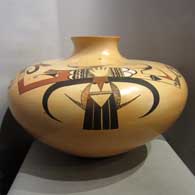
Fawn Navasie, Hopi, ApolychromeSikyatkistylejarwithfirecloudsanddecoratedwithafourpanelstylizedbirdhangingfromskybandandgeometricdesign
Hopi
$ 2800
rgho6d053
A polychrome Sikyatki style jar with fire clouds and decorated with a four panel stylized bird hanging from sky band and geometric design
9.5 in L by 9.5 in W by 5 in H
Condition: Excellent
Signature: Fawn with her deer print hallmark


100 West San Francisco Street, Santa Fe, New Mexico 87501
(505) 986-1234 - www.andreafisherpottery.com - All Rights Reserved
Sikyátki Revival
Hopi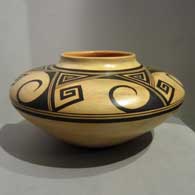
Les Namingha
White Swann
The name "Nampeyo" has been associated with much of the pottery produced on the Hopi Reservation in northeastern Arizona since the late 1800's. The potter, Nampeyo of Hano, just happened to be the right person in the right place at the right time. She re-interpreted and re-introduced various proto-historic forms, designs and color schemes, becoming the icon of a new/old approach to the making of pottery that was quickly adopted by other potters. This new style eventually came to be known as "Sikyátki Revival Ware", as it was associated with archaeological excavations that were conducted during the 1890s at the ruins of Sikyátki, the remains of a Hopi village which had existed between about 1375 and 1625 on the east flank of First Mesa. The ruins are about three miles north of Hano at First Mesa.
The common story is that Nampeyo's husband Lesou was hired by archaeologist Jesse Walter Fewkes in 1895 to help in the excavation of Sikyátki. As Fewkes told it, Lesou told Nampeyo about the pottery he'd seen at the site and his descriptions sparked her interest. She visited the site and saw first-hand the finely made, impeccably decorated jars and bowls that were being discovered and removed. Supposedly influenced by what she saw, Nampeyo’s work began changing to emphasize highly stylized bird forms, especially macaws and eagles. She also drew inspiration from other ancestral Hopi pottery types such as Jeddito and Awatovi Black-on-Yellows.
In reality, Lesou never worked for Fewkes and Nampeyo was well known for producing high quality Sikyátki Revival ware before Fewkes ever arrived in the area. No one called it that back then but it was what local traders like Thomas Keam and Lorenzo Hubbell were asking for when potters would bring them pots for sale. They wanted shapes, colors and designs like those that littered many of the old ruins in the area. The mounds at what were Sikyátki, Awatovi and Jeddito yielded many distinctive shapes and designs, long before Fewkes arrived.
Describing Sikyátki Revival Ware (or "Hano Polychrome," to be more accurate) is difficult. The pots are uniformly polychrome, employing vegetal and mineral paints that fire to become the reds, browns, yellows and blacks that we associate with Hopi pottery these days. The designs employ graceful, curvilinear lines that are well balanced across the three-dimensional surface of the pot. The designs also frequently incorporate religious symbols. The shapes are distinctive: wide shouldered flattened jars, low bowls with decoration inside and seed jars with small openings in their centers and tops that seem to defy the laws of physics as dictated by the clay. The base clays polish and fire to an unusually smooth texture, with colors ranging from golden yellow to orange to light brown. Since the fired surface came out so smooth, no slip had to be applied to the overall surface prior to applying the designs.
The pueblos of Hopi and Zuni had developed a close relationship in the 1860's when many Hopis left the Hopi mesas during a drought and a smallpox epidemic and waited at Zuni for conditions to improve so they could return. This connection influenced Hopi potters when they saw the Zunis use a white slip under their decorations. That practice returned to Hopiland when the potters returned and it was used in the production of "Polacca Ware," the most common form of Hopi pottery being made until the late nineteenth century. Polacca Ware is characterized by a white background with a "crackled" surface.
At the encouragement of local traders Thomas Keam and Lorenzo Hubbell, some Hopis started recreating old styles and designs based on the shapes and designs implied by ancient pot shards they found among the ruins left by their ancestors. Nampeyo was among the potters who were making quantities of non-utilitarian pottery for trade purposes and she heard Keam's call. Her innovation was to abandon the use of the white slip and apply her decorations directly to the polished clay body, just as she'd observed on the ancient pots. (The Navasie/Naha families still make their pottery using the white slip but now it's called "Walpi Polychrome.")
Nampeyo was relatively prolific in her making of pots. She also had an excellent eye for design and a steady hand for painting her designs. She and her descendants have set the quality bar for Sikyátki Revival (Hano Polychrome) pottery very high and that level of quality continues to rise today.
The tremendous diversity of design and technique in modern Hopi pottery stands as testament to its long history and the care with which today's Hopi and Hopi-Tewa potters seek to preserve their heritage while continuing to innovate and evolve the medium.
100 West San Francisco Street, Santa Fe, New Mexico 87501
(505) 986-1234 - www.andreafisherpottery.com - All Rights Reserved
Naha-Navasie Family Tree
-
Paqua Naha aka 1st Frogwoman (c. 1890-1955)
- Joy Navasie aka 2nd Frogwoman (1919-2012) & Perry Navasie
- Grace Navasie Lomaquahu (1953-) & Olson Lomaquahu
- Leona Navasie (1939-)
- Loretta Navasie Koshiway (1948-)
- Charles Navasie (1965-)
- Lana Yvonne David (1971-)
- Marianne Navasie (1951-2007) & Harrison Jim
- Donna Navasie Robertson (1972-)
- Maynard Navasie (1945-2003) & Veronica Navasie (1945-2003)
- Bill Navasie (1969-2004)
- Helen Naha aka Feather Woman (1922-1993) & Archie Naha (d. 1993)
- Burel Naha (1944-2025)
- Rainy Naha (1949-2026)
- Amber Naha (1991-)
- Tyra Naha (Tewawina) (1973-)
- Sylvia Naha Humphrey (1951-1999) Student of Helen, Rainy and Sylvia:
- Nona Naha (1958-2021) & Terry Naha
- Terran Naha
- Helen Naha & Hugh Sequi
- Cynthia Sequi Komalestewa (1954-)
- Agnes Navasie (Joy Navasie's mother-in-law)
- Eunice Fawn Navasie (c. 1920-1992) and Joel Nahsonhoya
- Dawn Navasie (1961-2022)
- Dolly Joe White Swann Navasie (1964-)
- Fawn Little Fawn Navasie (1959-)
- Student: Gloria Mahle
- Justin Navasie & Pauline Setalla (1930-)
- Agnes Nahsonhoya (1956-)
- Derek Nahsonhoya
- Dee Setalla (1963-)
- Gwen Setalla (1964-)
- Karen Namoki (1960-)
- Stetson Setalla (1962-2026)
- Agnes Nahsonhoya (1956-)
Disclaimer: This "family tree" is a best effort on our part to determine a generational order of the potters in this family. We have shown these diagrams to members of each family to get their input, too. This diagram is subject to change should we get better info. Some of the above info is drawn from Hopi-Tewa Pottery: 500 Artist Biographies, by Gregory Schaaf, © 1998, Center for Indigenous Arts & Studies.
(505) 986-1234 - www.andreafisherpottery.com - All Rights Reserved