
Click or tap to see a larger version
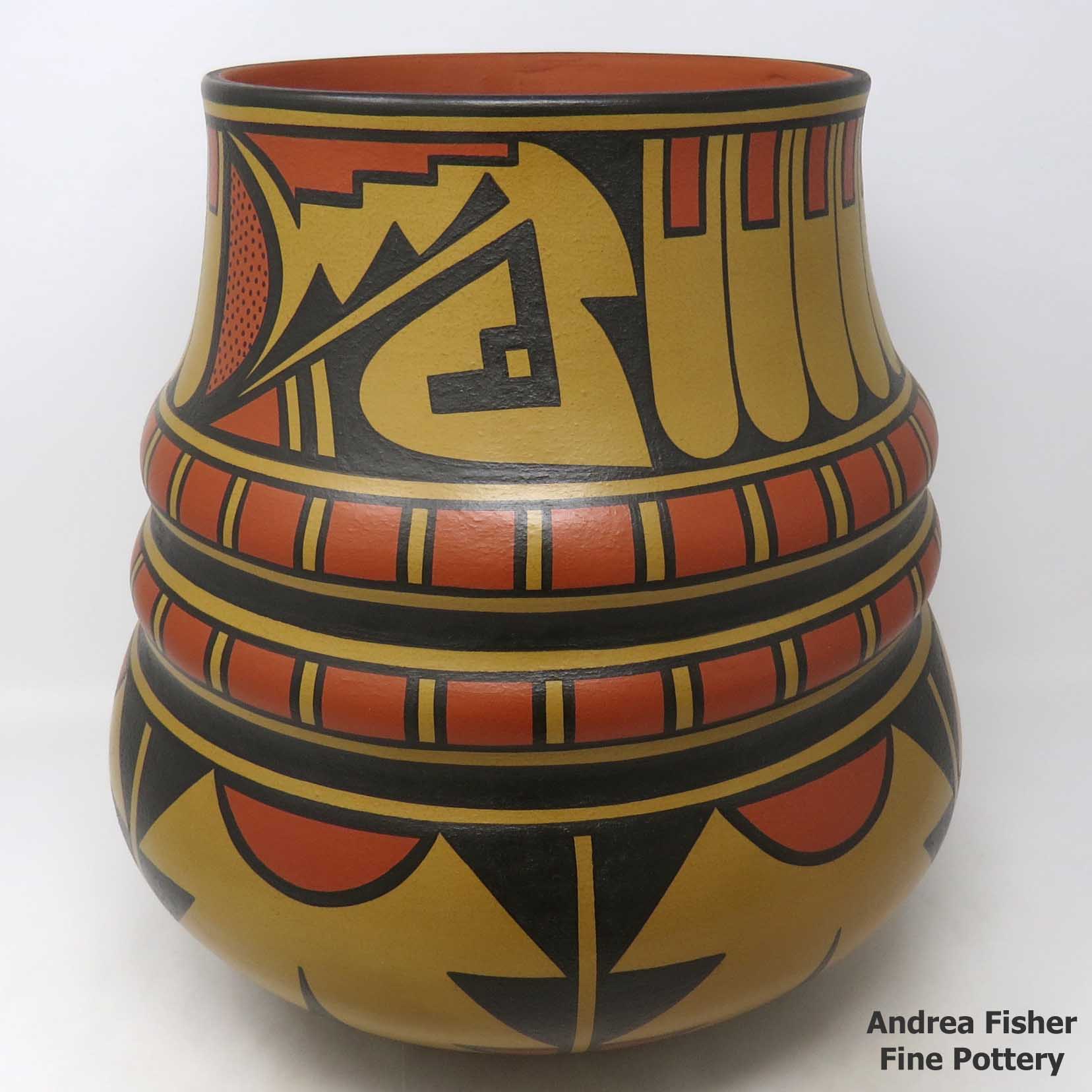
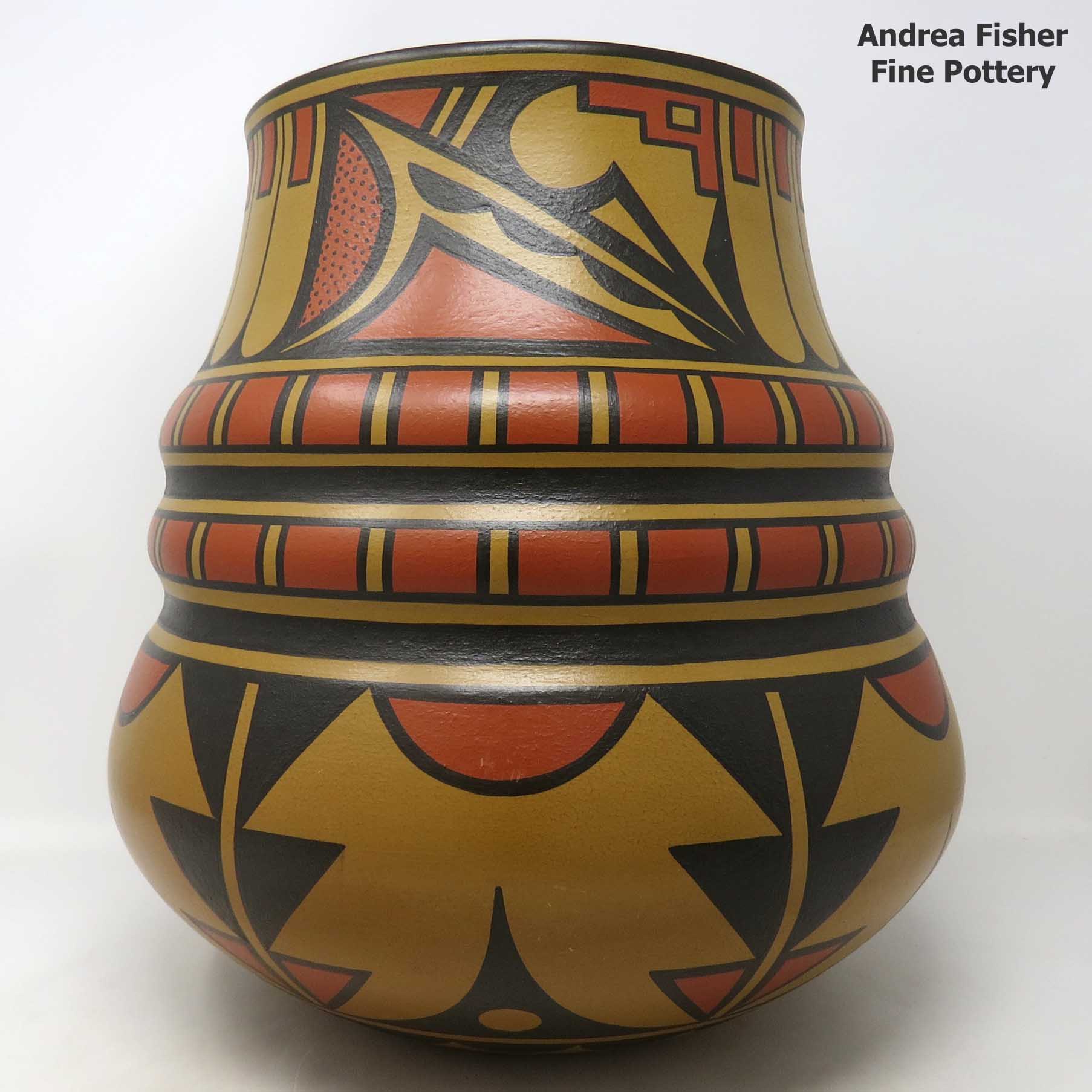
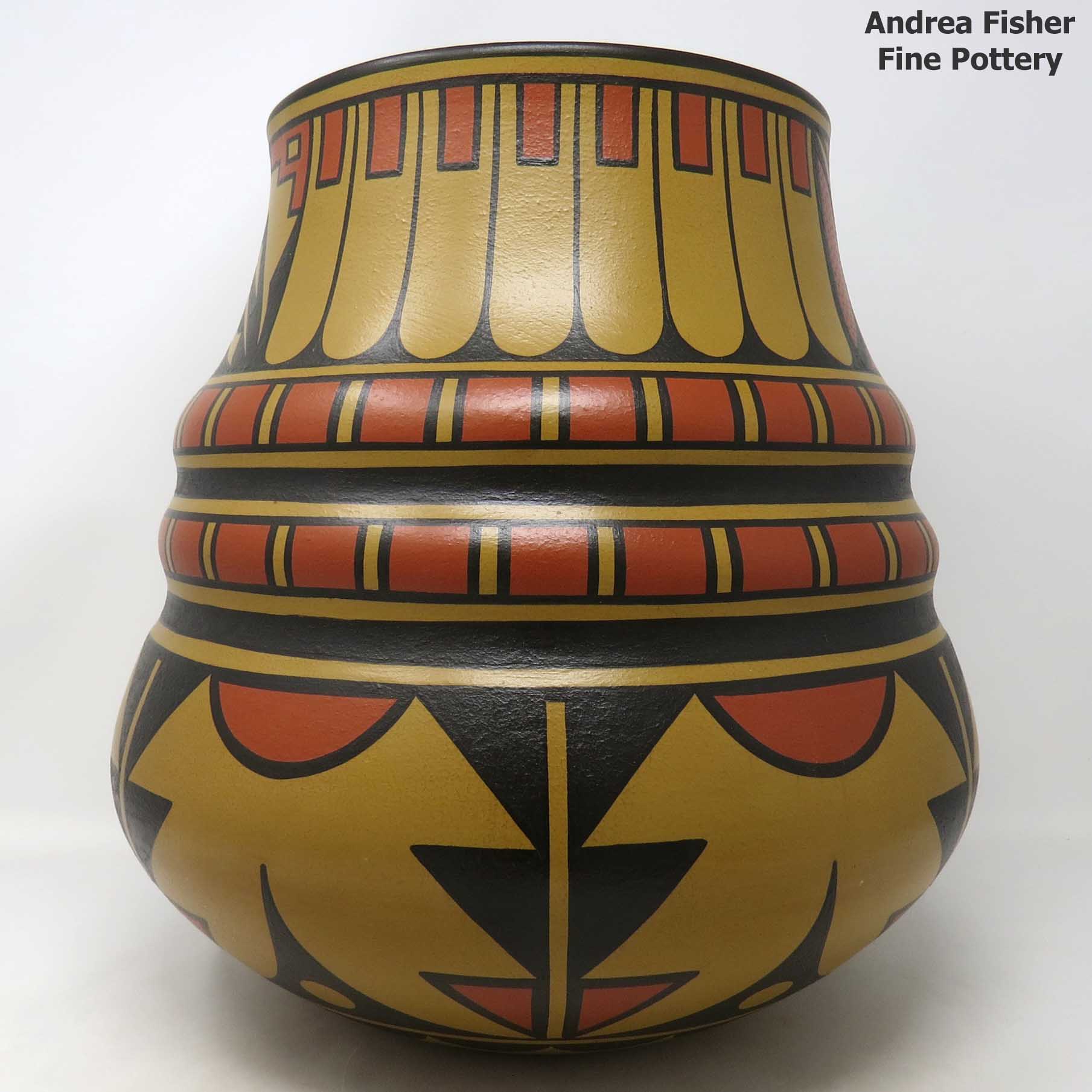
Cavan Gonzales, San Ildefonso, Polychrome triple shoulder jar with geometric design
San Ildefonso
$ 4800
cssig9408
Polychrome triple shoulder jar with geometric design
13 in L by 13 in W by 13.5 in H
Condition: Excellent
Signature: Cavan Gonzales Eagle Tail
Sale Price: $3900
Tell me more! Buy this piece!

(505) 986-1234 - www.andreafisherpottery.com - All Rights Reserved
San Ildefonso Pueblo
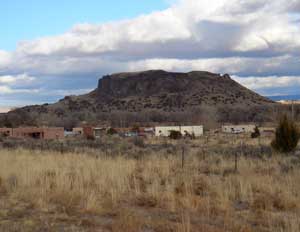
Black Mesa at San Ildefonso Pueblo
San Ildefonso Pueblo is located about twenty miles northwest of Santa Fe, New Mexico, west of Pojoaque, south of Santa Clara and straddling the Rio Grande. Although their ancestry has been traced to prehistoric pueblos in the Greater Mesa Verde area, the prehistoric pueblo at Tsankawi, in a non-contiguous parcel of Bandelier National Monument, is their most recent ancestral home. Tsankawi abuts the reservation on its northwest side.
Franciscan monks named the village after San Ildefonso and in 1617, forced the tribe to build a mission church on top of the village's main kiva. Before that the village was known as Powhoge, "where the water cuts through" (in Tewa). Today's pueblo was established as long ago as the 1300s. When the Spanish arrived in 1540, they estimated the village population at about 2,000.
That mission was destroyed during the Pueblo Revolt of 1680 and when Don Diego de Vargas returned to reclaim San Ildefonso in 1694, he found virtually all the Tewa people camped out on top of nearby Black Mesa. After an extended siege the two sides negotiated a treaty and the people returned to their villages. However, the next 250 years were not so good for them.
The swine flu pandemic of 1918 reduced the pueblo's population to about 90. Their population has grown to more than 600 since but the only economic activity available on the pueblo itself involves creating art in one form or another. The only other work is off-pueblo. San Ildefonso's population is small compared to neighboring Santa Clara Pueblo, but the pueblo maintains its own religious traditions and ceremonial feast days.
San Ildefonso is most known for being the home of the most famous Pueblo Indian potter, Maria Martinez. Many other excellent potters from this pueblo have produced quality pottery, too, among them: Blue Corn, Tonita and Juan Roybal, Dora Tse Pe and Rose Gonzales. Of course, the descendants of Maria Martinez are still important pillars of San Ildefonso's pottery tradition. Maria's influence reached far and wide, so far and wide that even Juan Quezada of the Mata Ortiz pottery renaissance in Chihuahua, Mexico, came to San Ildefonso to learn from her.
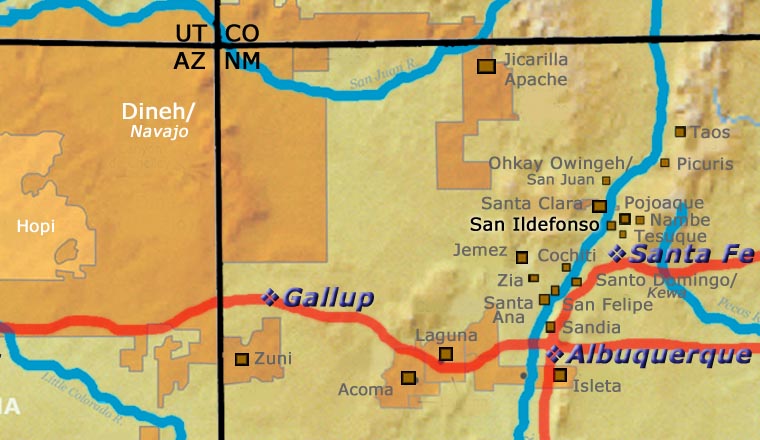
San Ildefonso Pueblo at Wikipedia
Pueblo of San Ildefonso official website
Pueblos of the Rio Grande, by Daniel Gibson
Photo is in the public domain
Maria Martinez Family Tree
Disclaimer: This "family tree" is a best effort on our part to determine who the potters are in this family and arrange them in a generational order. The general information available is questionable so we have tried to show each of these diagrams to living members of each family to get their input and approval, too. This diagram is subject to change should we get better info.
- Cipriana Peña (c. 1810-)
- Santana Peña (1846-) & Antonio Domingo Peña (1841-)
- Nicolasa Peña Montoya (1863-1904) & Juan Cruz Montoya
- Tonita Martinez Roybal (1892-1945) & Alfredo Montoya
- Isabel Montoya (1898-1996) & Benjamin Atencio
- Angelita Atencio Sanchez (1927-1993) & Santiago Sanchez
- Sandra Sanchez Chaparro
- Gilbert Atencio (1930-1995)
- Tony Atencio (1928-)
- Helen Gutierrez (1935-1993) & Frank Gutierrez (Santa Clara)
- Carol & James Gutierrez
- Kathy Gutierrez Naranjo & Ernest J. Naranjo
- Rose Gutierrez
- Geraldine Gutierrez Shije (1959-)
- Angelita Atencio Sanchez (1927-1993) & Santiago Sanchez
- Rayita Montoya
- Santana Montoya & Antonio Vigil
- Lupita Vigil Martinez (1918-2006) & Anselmo Martinez (1909-1965)
- Reyes Peña (d. 1909) & Tomas Montoya (d. 1914)
- Desideria Montoya (1889-1982)
- Maria Montoya Martinez (1887-1980) & Julian Martinez (1884-1943)
- Adam Martinez (1903-2000) and Santana Roybal Martinez (1909-2002)
- George Martinez (1943-) & Pauline Martinez (Santa Clara)(1950-)
- Adam Martinez
- Jesse Martinez
- Jolene Martinez
- Anita Martinez (d. 1992) & Pino Martinez
- Barbara Tahn-Moo-Whe Gonzales (1947-) & Robert Gonzales
- Aaron Gonzales (1971-)
- Brandon Gonzales (1983-)
- Cavan Gonzales (1970-)
- Derek Gonzales (1986-)
- Kathy Wan Povi Sanchez (1950-) & Gilbert Sanchez
- Corrine Sanchez
- Gilbert Abel Sanchez
- Liana Sanchez
- Wayland Sanchez
- Evelyn Than-Povi Garcia
- Myra Garcia
- Berlinda Garcia
- Myra Garcia
- Peter Pino
- Barbara Tahn-Moo-Whe Gonzales (1947-) & Robert Gonzales
- Viola Martinez/Sunset Cruz & Johnnie Cruz Sr.
- Beverly Martinez (1960-1987)
- Marvin Martinez (1964-) and Frances Martinez
- Marvin Lee Martinez
- Johnnie Cruz Jr. (1975-)
- Juan Diego Martinez (1915-1966) & Clara (Silva) Martinez
- George Martinez (1943-) & Pauline Martinez (Santa Clara)(1950-)
- Popovi Da (1921-1971) & Anita Da
- Tony Da (1940-2008)
- Adam Martinez (1903-2000) and Santana Roybal Martinez (1909-2002)
- Maximiliana Montoya (1885-1955) & Cresencio Martinez (1879-1918)
- Juanita Vigil (1898-1933) & Romando Vigil (1902-1978)
- Carmelita Vigil (1925-1999) & Nicholas Cata
- Martha Appleleaf (1950-)
- Erik Fender (1970-)
- Gloria Maxey (d. 1999)
- Angelina Maxey (1970-)
- Jessie Maxey (1972-)
- Martha Appleleaf (1950-)
- Carmelita Vigil (Dunlap) (1925-1999) & Carlos Dunlap (d. 1971)
- Carlos Sunrise Dunlap (1958-1981)
- Cynthia Star Flower Dunlap (1959-)
- Jeannie Mountain Flower Dunlap (1953-)
- Linda Dunlap (1955-)
- Carmelita Vigil (1925-1999) & Nicholas Cata
- Philomena Peña & Juan Gonzales & Ramona Sanchez (Robert's mother)
- Robert Gonzales & Rose (Cata) Gonzales (San Juan)
- Tse-Pe & Dora Tse-Pe (Zia)
- Candace Tse-Pe
- Gerri Tse-Pe
- Irene Tse-Pe
- Tse-Pe (1940-2000) & Jennifer Tse-Pe (Sisneros) (second wife, San Juan/Santa Clara)
- Tse-Pe & Dora Tse-Pe (Zia)
- Oqwa Pi (Abel Sanchez)(1899-1971) & Tomasena (Cata) Sanchez (1903-1985, Rose Gonzales' sister)
- Skipped generation
- Russell Sanchez (1966-)
- Skipped generation
- Louis Wo-Peen Gonzales & Juanita Wo-Peen Gonzales (1909-1988)
- Adelphia Martinez
- Lorenzo Gonzales (adopted) (1922-1995)
- Blue Corn (Crucita Calabaza - Lorenzo's sister) (1921-1999)
- Robert Gonzales & Rose (Cata) Gonzales (San Juan)
- Nicolasa Peña Montoya (1863-1904) & Juan Cruz Montoya
- Tonita Peña (1847-c. 1910)
- Anastacia Peña (c. 1876-)
- Luisa Peña
- Isabel Peña (c. 1881-) & Pasqual Martinez
- Teracita Martinez
- Petronella Martinez & Emiliano Abeyta (San Juan/Ohkay Owingeh)
- Philopeta Martinez (1925-) & Patrick Torres
- Elvis Torres (1960-)
- Torivia Martinez
- Philopeta Martinez (1925-) & Patrick Torres
- Anastacia Peña (c. 1876-)
- Santana Peña (1846-) & Antonio Domingo Peña (1841-)
Some of the above info is drawn from Pueblo Indian Pottery, 750 Artist Biographies, by Gregory Schaaf, © 2000, Center for Indigenous Arts & Studies
Other info is derived from personal contacts with family members and through interminable searches of the Internet.
Copyright © 1998-2025 by