
Daryl Candelaria
San Felipe

Daryl Candelaria was born into San Felipe Pueblo in April, 1970. His mother, Sara Candelaria, said he was finished with high school and sitting in front of the TV one day when she handed him a lump of clay and said "Make something." Shortly she was teaching him how to make pottery.
She had learned from her mother, Juanita Toledo of Jemez Pueblo. In the 1940s and 1950s Juanita had worked with Evelyn Vigil at Jemez to revive the Pecos style of pottery (when Pecos Pueblo was abandoned in the 1830s, the people were welcomed into Jemez Pueblo).
Daryl had a gift for making pottery but when he got interested in reviving San Felipe traditional styles and designs, there was almost nothing left to work with. So he got a job at the School for Advanced Research and researched the collections there for several years as he developed a form of "sherd" pottery that incorporates designs from different times and pueblos on the same piece. His design elements range from contemporary to designs hundreds of years old found on pre-contact pottery sherds.
Daryl has been winning awards for his work since the mid-1990s at Santa Fe Indian Market and at the Eight Northern Indian Pueblos Arts & Crafts Show. In 1999 he earned the First in Class and First in Division ribbons at Santa Fe Indian Market.
Daryl's work can be seen at the Indian Pueblo Cultural Center in Albuquerque, New Mexico; the Denver Art Museum; the Mint Museum of Art in Raleigh, North Carolina; the Museum of Indian Arts & Culture in Santa Fe, New Mexico; and at the Museum of Ceramics in South Korea.
100 West San Francisco Street, Santa Fe, New Mexico 87501
(505) 986-1234 - www.andreafisherpottery.com - All Rights Reserved

San Felipe Pueblo
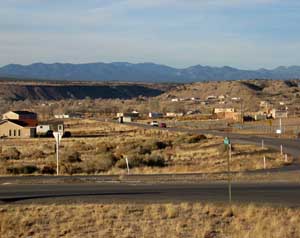
San Felipe Pueblo today
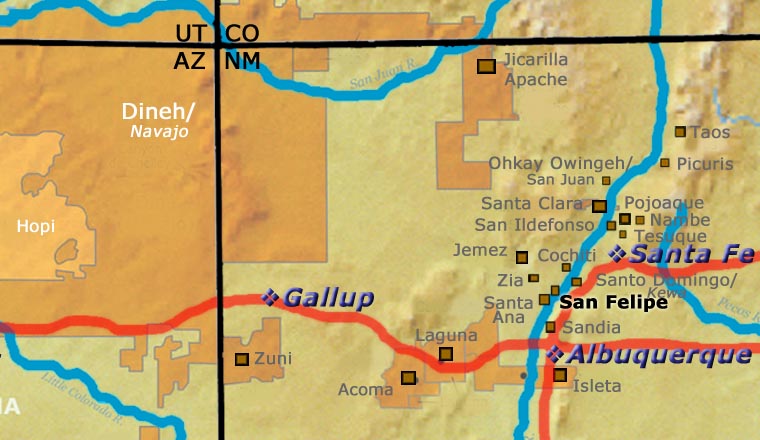
During the great migrations of the 13th century from the Four Corners area to the valley of the Rio Grande, the people of Cochiti, Santo Domingo and San Felipe were one tribe, carrying with them the heart of what we now know as the Eastern Keres culture and religion. Archaeologists feel they mostly traveled from the Four Corners area around the north side of the Gallinas Highlands and the Jemez Mountains, staying south of the simultaneous Tewa migration happening in the Chama and Ojo Caliente River valleys. On arriving near the Rio Grande they settled in Frijole Canyon, on the southeastern side of the Pajarito Plateau. In the area now known as Bandelier National Monument, they built the village of Tyuonyi, and dug many residences into the soft volcanic tufa walls of the canyon. However, over time the Pajarito Plateau got too dry, too, and the people decided to move downstream into the valley of the larger Rio Grande. Once at the Rio Grande, they decided to keep moving south as the east bank was occupied by the Tewa and Tanoan people. Disagreements among the Keres over where to settle split the people into what is now the Cochiti, Santo Domingo and San Felipe tribes.
When Francisco de Coronado arrived in 1540, there were several Tiwa pueblos in the Middle Rio Grande area. He and his men attacked them all, stealing whatever food they could and inadvertently making sure all the natives were exposed to European diseases. When the Spanish came back in 1598, the Tiwa had been reduced from fifteen villages to two: Isleta and Alameda (now Sandia), and both were off to the south. Instead, there were now two Keres-speaking villages, one on either side of the Rio Grande, in the valley directly north of the ruined pueblo at Kuaua (today's Bernalillo). The main Keresan villages were comprised of large two-and-three-story structures plus a couple hundred outlying dwellings. The Spanish Franciscan monks forced the San Felipes to build their first mission church on top of their main kiva, next to the east village, around 1600.
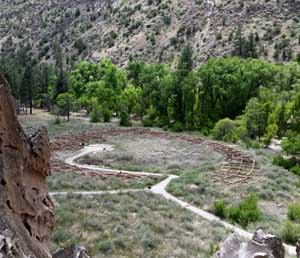
Part of the San Felipe ancestral home
The people of San Felipe participated in the Pueblo Revolt of 1680 but killed no Spaniards nor any priests. Governor Otermin returned with troops in 1681 and found San Felipe abandoned as the people had hidden themselves atop nearby Horn Mesa. The Spaniards looted and burned the pueblo before returning to Mexico. When Don Diego de Vargas came back in 1692, the people chose to surrender and be baptised rather than flee or fight. To test the peace they first settled atop nearby Santa Ana Mesa. A few years later they descended into the Rio Grande Valley and built the beginnings of today's pueblo.
San Felipe has always had more arable land than most of the other pueblos and is still known for its agricultural products, although in modern times, most residents commute off-pueblo to work. The long-held isolationism of the San Felipe people has contributed to the loss of many traditional activities, including the making of pottery. Most San Felipe potters active today either learned the art on their own or learned from artisans at other pueblos. The revival of San Felipe pottery tradition is further complicated by the fact so few people remember where good clay might be found on the pueblo lands.
100 West San Francisco Street, Santa Fe, New Mexico 87501
(505) 986-1234 - www.andreafisherpottery.com - All Rights Reserved